Executive summary
Enterprise AI has moved rapidly from experimentation toward autonomous and semi-autonomous agents.
Yet the journey from an impressive demonstration to a dependable production business process remains difficult.
Industry research continues to show organizations struggling to scale AI into production. Reported obstacles include infrastructure readiness, workflow redesign, integration, governance, and operational risk.123
The problem is often framed around the AI model.
TekCapitol Research proposes a different way to examine the production gap:
The model may work while the workflow around it remains broken.
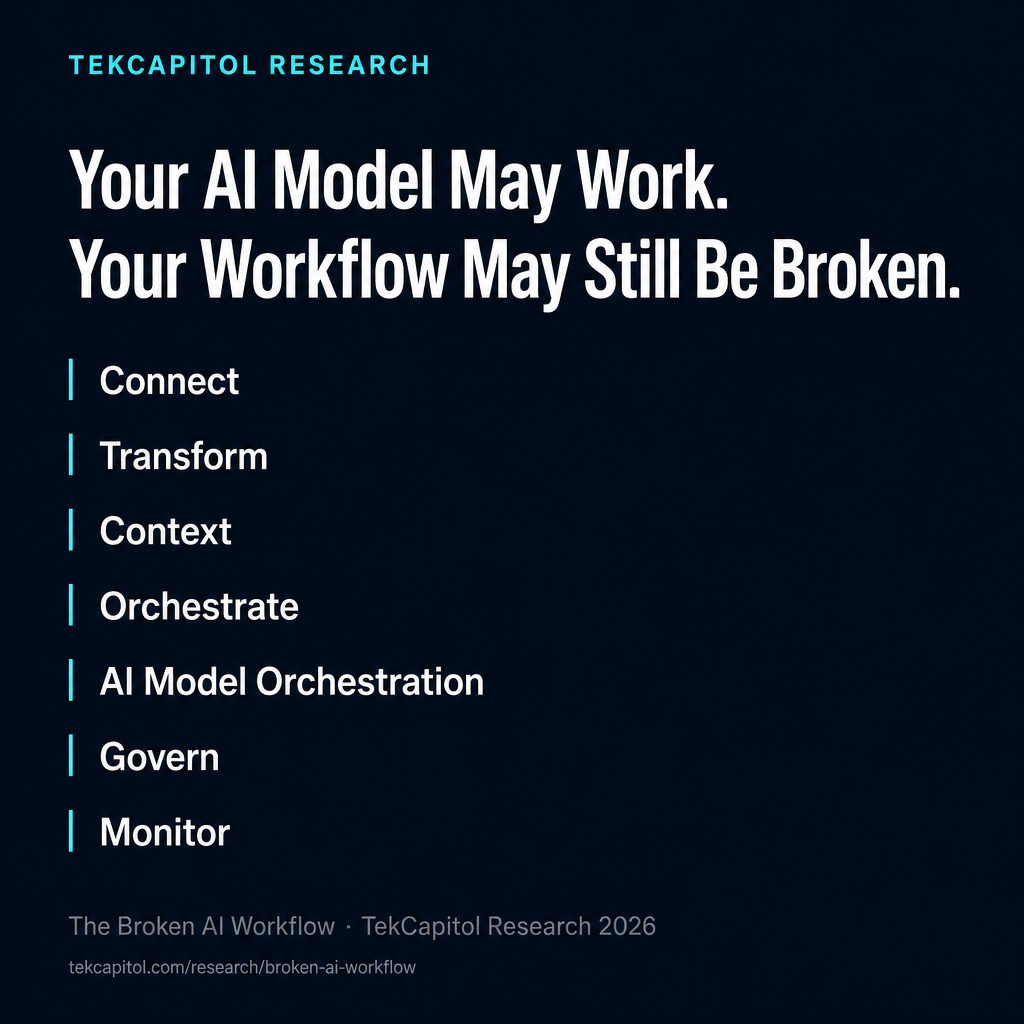
For an enterprise agent to perform a real business process, a much larger production path must work. TekCapitol identifies seven layers where that path can break:
- Connect
- Transform
- Context
- Orchestrate
- AI Model Orchestration
- Govern
- Monitor
This paper examines each layer and proposes a workflow-level approach to diagnosing and fixing production readiness. Product methods appear later. The argument does not depend on buying a platform first.
1. The production gap
A prototype often operates under favorable conditions.
The data is known. The APIs work. The test cases are predictable. Permissions are available. Context may be manually supplied. A human is watching.
Production changes those assumptions.
The workflow now encounters changing records, APIs, permissions, schemas, policies, users, models, business rules, and external systems.
And unlike a chatbot answering a question incorrectly, an enterprise agent may eventually be allowed to:
- change a customer record
- issue a refund
- create a purchase order
- approve a transaction
- update an account
- modify a case
- initiate a payment
- change another system of record
The production question therefore changes.
It is no longer simply: can the model answer correctly?
It becomes: can the complete workflow perform this business process reliably, safely, and under the right authority?
Gartner has predicted that over 40 percent of agentic AI projects will be canceled by the end of 2027, citing escalating costs, unclear business value, or inadequate risk controls, not a simple failure of model quality.1 McKinsey's 2025 State of AI survey found that 88 percent of respondents report regular AI use in at least one business function, while most organizations remain in experimenting or piloting stages, with approximately one-third reporting that they have begun to scale AI programs.2
- Enterprise Systems
- Connect
- Transform
- Context
- Orchestrate
- AI Model Orchestration
- Govern
- Action
- Monitor
A strong model cannot compensate for a broken production workflow.
2. AI production is a workflow problem
An AI workflow, as used in this paper, is one business process that an AI agent or agentic system is permitted to execute across enterprise systems.
Example: approve this refund.
That apparently simple instruction may require the workflow to:
- identify the customer
- retrieve the transaction
- connect to the order system
- reconcile identifiers across systems
- retrieve the current refund policy
- establish current business context
- determine eligibility
- determine current authority
- invoke the appropriate model
- make a decision
- potentially request human approval
- write the outcome into a system of record
- preserve evidence of what happened
A failure anywhere in that path can invalidate the business outcome.
McKinsey reports that AI high performers are far more likely than others to redesign individual workflows rather than layer tools onto existing process design.2 Google Cloud's infrastructure research similarly finds that production-grade agentic systems place demands on security, data, and operating foundations that many estates have not yet met.34
Voluntary risk frameworks already treat AI as a lifecycle problem, not a model-only problem. NIST's AI Risk Management Framework organizes work around Govern, Map, Measure, and Manage.5 OWASP's agentic guidance focuses on risks that appear when systems plan, call tools, and act across workflows.6
3. The seven-layer workflow diagnostic
Each layer below is a production question. A workflow can fail at any of them even when the underlying model performs well.
Connect
Can the workflow reliably reach every system, object, API, and service required to perform the business process?
A modern workflow may cross Salesforce, SAP, Snowflake, ServiceNow, identity systems, internal databases, payment services, and proprietary applications. The existence of an API does not make the workflow production ready.
Where it breaks
- missing APIs
- incorrect OAuth scopes
- excessive service-account permissions
- inaccessible objects
- identity mismatches
- connector drift
- undocumented dependencies
- unreliable legacy integrations
- write behavior that differs from read behavior
Diagnose
Determine required systems, objects read, objects changed, authentication method, authorization scope, identity mappings, dependencies, and failure behavior.
Fix
Typical remediation includes connector configuration, identity mapping, least-privilege access, API contracts, retries, failure handling, and missing integrations.
Transform
Does information retain the correct business meaning as it moves between systems?
Zendesk may identify a customer with org_id. Salesforce may use AccountId. Snowflake may use an internal customer key. SAP may use a billing identifier. Every system may be connected correctly while the workflow still reasons about the wrong customer.
Where it breaks
- broken joins
- inconsistent entity definitions
- stale transformations
- duplicated records
- schema drift
- timestamp mismatches
- currency or unit conversion errors
- missing lineage
- analytics transformations reused for operational decisions
Diagnose
Ask: can we prove that the information reaching the decision point represents the correct entity, state, and point in time?
Fix
Typical remediation includes canonical mappings, validation rules, transformation tests, freshness requirements, schema contracts, lineage, and reconciliation rules.
Context
Does the workflow know enough about what is true right now?
An agent approving a refund may know the customer, the transaction, and the refund amount. It may still not know that the policy changed yesterday, that another refund is pending, that the account is under investigation, that customer status has changed, or that the initiator's authority was revoked this morning.
All underlying data may be accurate while the assembled decision context remains incomplete.
Where it breaks
- stale retrieval
- missing policy
- missing authority context
- contradictory sources
- stale memory
- lost workflow state
- irrelevant retrieved information
- incomplete business context
Diagnose
Identify context required, authoritative source, freshness requirement, precedence rules, memory boundaries, policy context, authority context, and exception conditions.
Fix
Typical remediation includes context contracts, freshness thresholds, authoritative-source rules, retrieval filters, memory restrictions, policy retrieval, and conflict-resolution rules.
Orchestrate
Does the business process execute in the correct sequence?
The workflow may contain deterministic code, APIs, databases, models, agents, sub-agents, and human approval points. Strong components can still create a broken workflow when assembled incorrectly.
Where it breaks
- missing preconditions
- incorrect sequence
- uncontrolled retries
- duplicate actions
- lost state
- race conditions
- partial execution
- humans inserted too late
- missing rollback
- poor failure propagation
Diagnose
Map business intent to workflow steps, decisions, actions, and system-of-record writes. Identify every branch where the process can materially change the business outcome.
Fix
Typical remediation includes explicit workflow states, checkpoints, retry limits, idempotency, human escalation, compensation logic, failure handling, and action boundaries.
AI Model Orchestration
Is the right intelligence being used for the right task under the right constraints?
A modern workflow may involve multiple models, routing, retrieval, tools, agents, sub-agents, and deterministic services. The problem is no longer simply model quality. It is model orchestration.
Where it breaks
- wrong model for the task
- uncontrolled model substitution
- prompt drift
- inconsistent structured output
- hallucinated tool parameters
- weak fallback behavior
- unnecessary model calls
- token overruns
- latency overruns
- model changes without regression testing
Diagnose
Evaluate model selection, task and model fit, prompts, tool contracts, structured output, fallback behavior, confidence thresholds, evaluation criteria, cost limits, latency limits, and model versions.
Fix
Typical remediation includes deterministic routing, schema-constrained output, model evaluation, fallback rules, tool parameter validation, version management, and token boundaries.
Govern
May this workflow perform this action, right now, under current policy and authority?
Traditional identity and access management remains essential. But technical access does not always answer the business question.
An agent may have permission to modify Salesforce. That does not necessarily mean this workflow may change this record, for this purpose, under these current circumstances.
Where it breaks
- excessive authority
- stale authority
- policy existing only in documents
- unclear workflow ownership
- missing approvals
- inadequate audit evidence
- unclear accountability
- inability to stop an action
Diagnose
Determine workflow owner, business authority, sensitive actions, approval thresholds, applicable policies, human intervention requirements, audit requirements, and write authority.
Fix
Translate appropriate governance requirements into operational workflow controls. NIST treats Govern as a core function of AI risk management, not an afterthought once the model is selected.5
Monitor
Will the enterprise know when something that was true at deployment stops being true?
Production readiness is not permanent. Models change. Prompts change. Schemas change. APIs change. Policies change. Employees change roles. Permissions change. Business data changes.
Where it breaks
- only infrastructure is monitored
- no decision provenance
- no workflow-level trace
- schema drift goes unnoticed
- policy changes are disconnected from production
- authority changes go unnoticed
- incidents are discovered after the write
Diagnose
Define the conditions that must remain true for the workflow to continue operating safely.
Fix
Monitor workflow state, schema, dependencies, models, policies, authority, sensitive decisions, external actions, and production exceptions.
The monitoring question should evolve from "Did the agent run?" to "Is the workflow still operating inside its intended business boundaries?"
Connect
Can it reach what it needs?
Transform
Does the data still mean the right thing?
Context
Does it know what is true now?
Orchestrate
Does the process execute correctly?
AI Model Orchestration
Is the right model doing the right job?
Govern
May this action happen now?
Monitor
Will we know when something changes?
TekCapitol Workflow Readiness Framework. Download the LinkedIn graphic.
4. The workflow is only as ready as its weakest critical layer
A workflow should not be considered production ready simply because model evaluation scores are strong.
The table below is an illustrative workflow profile. It is not a TekCapitol research finding and is not an industry average.
| Layer | Readiness |
|---|---|
| Connect | 82 |
| Transform | 61 |
| Context | 44 |
| Orchestrate | 78 |
| AI Model Orchestration | 86 |
| Govern | 39 |
| Monitor | 58 |
A high-performing model does not compensate for weak context or governance.
Illustrative example. Not benchmark data.
Illustrative workflow readiness profile
Illustrative example. Not benchmark data. Context and Govern are the weakest layers in this profile.
5. Diagnose before you rebuild
Organizations often respond to AI production problems by adding infrastructure, models, platforms, governance tools, or engineering resources.
Sometimes those investments are necessary. Sometimes only a few specific gaps are preventing one workflow from entering production.
The first objective should be to identify those gaps.
TC Diagnose™ evaluates one business workflow across the seven production layers. It produces a workflow readiness profile, identified production gaps, severity, affected layer, evidence, recommended remediation, and a prioritized gap queue.
The question is not: is our enterprise AI-ready?
It is: is this workflow ready to perform this business process in production?
6. Fix what is actually broken
Once gaps are identified, they can be addressed individually.
TC Fix™ converts diagnosed gaps into remediation requirements and implementation artifacts. Examples:
- Connect. Correct Salesforce authorization scope.
- Transform. Map Zendesk
org_idto SalesforceAccountId. - Context. Retrieve current customer credit status before the decision.
- Orchestrate. Insert human approval above the required threshold.
- AI Model Orchestration. Validate generated parameters against the tool schema.
- Govern. Revalidate current authority before a sensitive write.
- Monitor. Alert when the workflow runs against an unapproved policy version.
The remediation objective is not: fix everything in the enterprise AI stack.
It is: fix what prevents this workflow from being production ready.
7. From diagnose and fix to runtime protection
Diagnosis determines whether the workflow is ready. Fix addresses the identified gaps.
But production conditions continue to change after deployment. That introduces another requirement: runtime protection.
A workflow that was authorized yesterday may encounter a different situation today. A user may lose authority. A policy may change. Business context may shift. A model may produce an unexpected action.
Before a sensitive system-of-record change occurs, the workflow may need another question answered: may this write happen now?
This is where TC Protect™ extends workflow assurance into runtime: pause before write when the live path would otherwise mutate a system of record without a current Allow, Pause, or Deny decision. That control is a called gate. If the orchestrator skips it, the write is not under Protect.
TekCapitol does not replace Salesforce, SAP, Snowflake, or the customer's identity stack. It examines whether the production path around the model can be trusted.
8. The emerging discipline of AI workflow assurance
The enterprise AI conversation has progressed through several questions.
First: which model should we use?
Then: which agent framework should we use?
Then: how do we connect the agent to enterprise systems?
The next question is becoming operational: can this business workflow be trusted in production?
That cannot be answered by inspecting the model alone. It requires examining the complete production path: from enterprise systems and transformations to context, orchestration, governance, action, and monitoring.
TekCapitol refers to this discipline as Real-Time AI Action Assurance.
The operating principle is simple. Diagnose the workflow. Fix what is broken. Protect it in production.
About this research
This paper synthesizes publicly available industry research, standards, emerging agentic AI risk guidance, and TekCapitol's workflow assurance framework.
The seven-layer model in this paper (Connect, Transform, Context, Orchestrate, AI Model Orchestration, Govern, Monitor) is TekCapitol's framework for analyzing production readiness of one workflow. It is a diagnostic lens for the path from systems to action. It is not a claim that every TekCapitol product screen uses the same seven labels.
Illustrative diagnostic scores in this publication are examples intended to explain the methodology and should not be interpreted as observed industry benchmarks.
As TekCapitol completes additional TC Diagnose™ assessments, anonymized and aggregated workflow findings may contribute to future editions of the TekCapitol State of Enterprise AI Workflow Readiness research. Those editions will not publish layer-level percentages or average scores until sufficient real diagnostic data exists.
Sources
- ↑ Gartner, "Gartner Predicts Over 40% of Agentic AI Projects Will Be Canceled by End of 2027," newsroom, 25 June 2025. gartner.com
- ↑ McKinsey & Company, "The State of AI: Global Survey 2025." Regular AI use in at least one business function: 88 percent of respondents. Majority still experimenting or piloting; approximately one-third scaling. mckinsey.com
- ↑ Google Cloud, "2025 State of AI Infrastructure" report. Survey of 500+ technology leaders: 98 percent of organizations actively exploring generative AI, with 39 percent already deploying it in production. Data quality and security among the greatest adoption challenges. cloud.google.com
- ↑ Google Cloud, "State of AI infrastructure report overview." Later survey of more than 1,400 senior IT leaders: 83 percent of organizations say they require infrastructure upgrades to support production-grade agentic AI. cloud.google.com/blog
- ↑ National Institute of Standards and Technology, Artificial Intelligence Risk Management Framework (AI RMF 1.0), NIST AI 100-1, January 2023. Voluntary functions: Govern, Map, Measure, Manage. doi.org/10.6028/NIST.AI.100-1. See also NIST AI 600-1, Generative Artificial Intelligence Profile, 26 July 2024. nist.gov
- ↑ OWASP GenAI Security Project, "OWASP Top 10 for Agentic Applications for 2026," 9 December 2025. Peer-reviewed risks for autonomous and agentic systems that plan, act, and decide across workflows. genai.owasp.org
Is your workflow ready for production?
You do not need to assess every AI initiative in the enterprise at once. Start with one business workflow. Identify what is ready. Find what is broken. Fix the production gaps.
One workflow. Seven layers. A clear path to production.